
Origin Stories
How Carolina Bays Came to Be
Carolina Bays formed at different times, with sediments aged from a few thousand to tens of thousands of years ago, with the oldest just over 100,000 years ago. The bulk of evidence indicates that most bays predate the Holocene (~11,700 years ago), the time of the last glacial maximum. Some geologists interpret these data to suggest that bays have been formed periodically over tens of thousands of years, while others hypothesize a single origin >100,000 years ago and subsequent modification and alteration of those bays over time.
Over the years, there have been many possible explanations proposed for the formation of the Carolina Bays, including spring basins, enclosed soundlets, groundwater solution depressions, artesian springs, wallows from large animals, streamlined groundwater forming limestone sinks, deflation hollows, intersecting river terraces, burning peat leading to subsidence, wind modified and ponded frozen ground, hydrogen seepage, meteorite or comet impacts, and shockwaves from a comet explosion.
While there is not complete scientific consensus, the majority of the evidence suggests formation from directional wind and wave action in relic thermokarst lakes.
Directional winds and waves
In areas where the ground freezes, repeated freezing and thawing along with directional winds create depressions in the landscape with similar shapes. Thermokarst lakes can be seen today in the arctic, and geologists theorize that the Carolina Bays formed with similar processes during the last glacial period when what is now the southeastern US was much colder and drier. These depressions can be further modified by wind and water to create features such as sand rims.
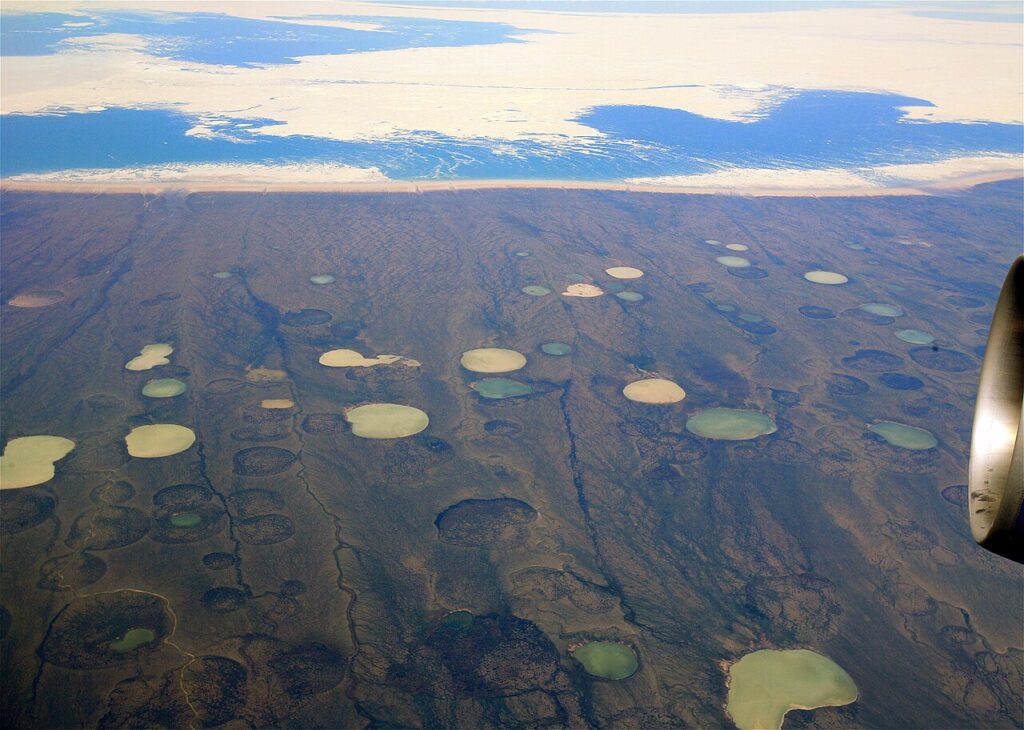
Geologist have found that the orientations of the Carolina Bays are consistent with the wind patterns that existed during the Wisconsin glaciation (15,000 – 80,000 years before present), as reconstructed from the orientations of parabolic dunes in river valleys. Explains shape, orientation, and different ages of sediments.
Boring
Meteor or comet impact
A University of North Carolina geologist named William Prouty first proposed the meteor or comet impact theory in the 1950’s, and others have built upon it. The leading theory is that a meteor or comet impacted glaciers near the Great Lakes region and chunks of ice were thrown up in the air, landing across the east coast creating the elliptical depressions and pushing up sand rims on the far edge.
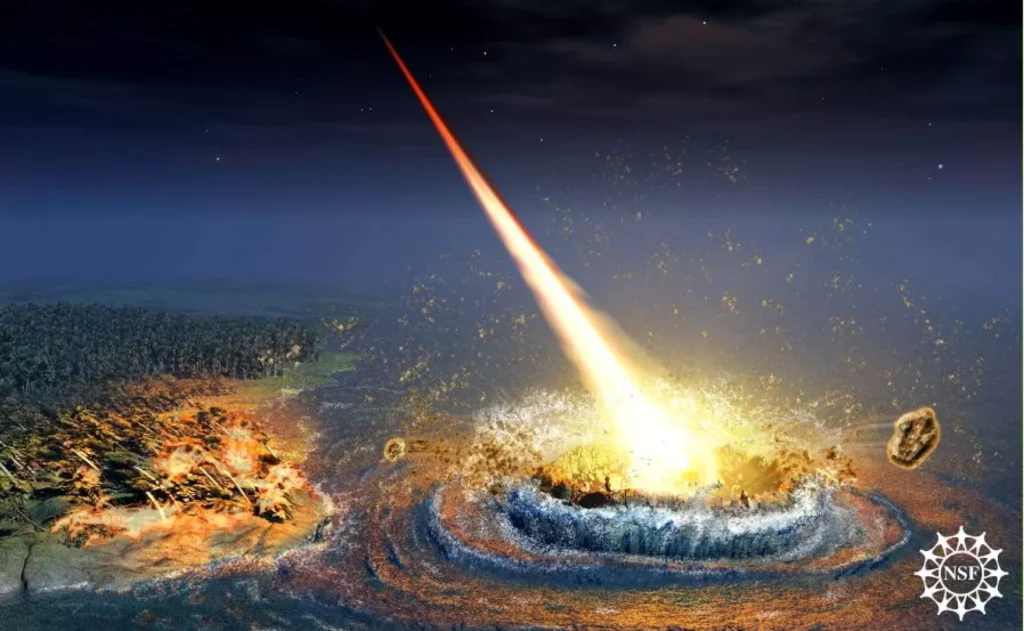
Explains common orientation and shape. The orientation of the long axis of bays changes with change in latitude, pointing back towards the Great Lakes. Overlapping bays could be multiple ice chunks hitting staggered close together. Prouty conducted lab experiments simulating an impact and produced depressions similar to Carolina Bays.
No meteor or comet material has been found in bays. Wide-ranging soil ages suggest bays were created periodically across tens of thousands of years, not all at once.
Burning Peat
A study of Lake Mattamuskeet in Hyde Co, NC revealed evidence in the sediments that a large peat fire during a dry period created the large depression, and subsequent water and wind shaped the basin and rim.

Clear evidence of charcoal in Mattamuskeet sediments. Large-scale modern day peat fires have created open water lakes.
While some consider Lake Mattamuskeet a Carolina Bay, it does not have the classic shape and orientation. Extensive peat deposits do not occur in all areas with bays (e.g. the areas with clay-based bays).
Dinosaur, Giant Beaver, or Whale Wallows

Would be awesome
Probably not